
Free HDR video tutorial

Free HDR video tutorial

MASTER EXPOSURE BLENDING

Find the best ones

Find the best ones

TOP PHOTOGRAPHY SPOTS

Free wallpapers

Free wallpapers

HIGH-RESOLUTION WALLPAPERS

This will be a little rant. I haven’t posted one in a long time, so it’s time for one again.

As probably every photographer, I get a lot of requests from different people, asking if I would provide my photos for free. In the past, I did so from time to time, but looking back, I think it was only because of my beginners naivety. You know how it is. When you start taking photos, it’s just such a great feeling to see you photos used somewhere. Anywhere is great. But over time, I learned that doing so is never good. It just makes someone else profit from my work, and I get nothing from it.

If you think about it. If I let someone use a photo for free, who payed for the photo? I did. I payed for something so some company can use it and profit from it. I payed with my time, with money for the equipment, sometimes even with my health. And not only that. If I provide a photo to someone, the photo lowers in value. It happens over and over that potential customers first question is: Is someone already using this photo? And if yes, their interest is gone.

WatermarkSo some time ago, I decide to stop this practice completely. But I still get the requests, and so many times I’m just shocked. You would not believe the excuses why they can’t afford the photos, why they should not pay for the photos, or what is commercial use and what isn’t. It takes so much to stay civil while replying to such emails. Would you believe someone who told you that they want to make a brochure and they made no budget for the photos? That they think that promotional material is not commercial use? That non-profit organizations have no budget at all? I don’t think so.

Sometimes this just reads as an insult. Insult to me and my work. It’s funny, to read from companies like this, how great my work is, how great my photos are, how much they want to use them, and right after that, how worthless it is. Yes, they gave a value to all my work. And the value they gave was a big fat zero. It’s even funnier, if you take into account, that the person writing to me, get’s even payed for the time spend writing the email. So even that is more valuable than my work.

One interesting thing I noticed is, especially by non-profit organizations, is, that mostly the bigger ones think they should get the photos for free. The smaller ones, usually ones that promote arts, approach me about buying the photos, even if they have a limited budget. I usually agree to provide photos for them at a big discount, as I also like to support those causes. But bigger companies, boosting on their web-pages how much money they have to work with, don’t even ask for the price. They either get it for free, or they don’t care.

You would think that this is all about money, and you are right. I would love to just take photos for fun. To just do what I like to do. But until I can go to a shop, and say, I have no budget this week, I take it for free, this is just not possible. And I hope one day, people like this will understand that. One good thing is, that there are also good companies. The ones that value the work and also pay fairly for it. It’s such a pleasure to work with those.

And to every photographer out there. Never work for free. It’s never worth it.

I actually had the pleasure to cruise on the Danube on a ship very similar to this a few years ago. It is so great. You can just relax on the deck and watch the beautiful scenery pass by. Really a great experience.

So this photo is taken opposite Durnstein in Austria. Really one of the most beautiful views in the area. I tried a little different type of editing here, so this is not HDR, as all edits were done just using Photoshop and Color Efex. But as there was not such a huge dynamic range here, there was no need for HDR anyway :)

Cruising on the Danube

Technique: Photoshop edit, Number of exposures: 1, Camera Model: Canon EOS 5D mark II, Lens: Canon 70-200mm F2.8 IS II, Focal length: 88mm, Aperture: 9, Middle exposure time: 1/250s, ISO: 100, Tripod used: no, Location: 48.394547, 15.515440

For this weeks process post, I will show you how I edited this sunset photo of the lighthouse on the Neusidlersee in Austria. So let’s get started.

As you can see form the comparison to the original photo, this was a perfect place to use HDR. I was shooting directly into the sunset, so the sky was quite bright, and the lighthouse was in the shadow.

Close to the groundFinished photo
Close to the groundOriginal photo

I took 6 exposures in total here, but while reviewing them in Photoshop, I decided not to use the brightest one. The reason for this was, that when you use Oloneo Photoengine and you include a very bright (or very dark) exposure, it will make the result much brighter than you need (or darker) and further editing is harder. So by leaving that exposure out, the result is much better, and less corrections are needed. You can easily experiment with Photoengine to see the difference.

Close to the groundExposures in Lightroom
Close to the groundCombined in Photoengine

So I first corrected chromatic aberrations and lens distortions in Lightroom, from where I exported all the files as 16-bit tiff files. Then I loaded them into Oloneo Photoengine. There I tweaked the strength, contrast and fine exposure, to get a pleasing result. From there I continued in Photoshop with the following edits:

1. Oloneo Photoengine result
2. Just a copy of the 1st layer, on which corrected the rocks in the foreground. As there was a little camera movement while I took this shot, it created an ugly ghosting around them, and I had to correct that.
3. Cleaned few dust spots in the photo
4. Used the +1EV exposure, to brighten the lighthouse.
5. A little noise reduction
6. Color balance to make the shadows a little warmer.
7. Color efex Tonal contrast to get more detail into the clouds

And that’s all I did with this image. To find out more on how I edit, check out the guides and before after categories on this blog, or check out my video tutorial series here:
Master exposure blending

FAQ about HDR

I added a new page, containing the Frequently asked question about HDR that I get quite a lot. So feel free to check them out, and if you want to ask something, or think I should add a particular questions, please leave it in the comments.

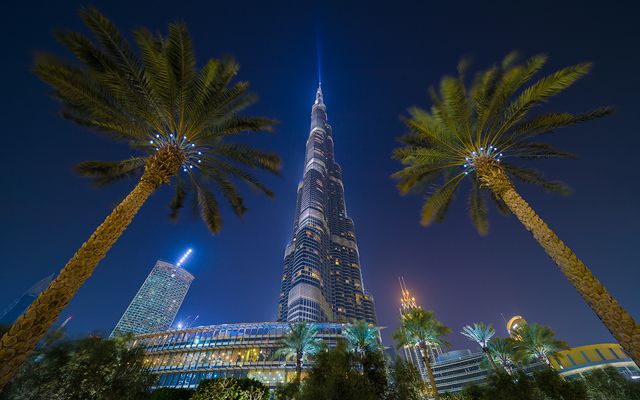
Night view of the Marina

I was just looking at the news about the fire in Dubaim Marina, and if I’m not mistaken, it was the building in the middle of this photo. Good to hear that no one was injured as everyone got out on time. Still, the photos of the fire looked really scary.

For the photo today, this is the Dubai Marina, as seen from the Palm Jumeirah. It’s a HDR from 4 exposures, created in Oloneo Photoengine, finished in Photoshop.

Night view of the Marina

Technique: Oloneo Photoengine, Number of exposures: 4, Camera Model: Canon EOS 5D mark II, Lens: Canon 70-200mm F2.8 IS II, Focal length: 102mm, Aperture: 5.6, Middle exposure time: 12s, ISO: 200, Tripod used: yes, Location: 25.097384, 55.124269

What is HDR?

HDR stands for Hight dynamic range, and it’s a technique of taking multiple photo of the same scene, to be able to capture the whole range of lights and shadows. Check out my longer description of HDR in this article dedicated completely to this question.

Do I need to HDR every photo?

No. As every post-processing technique, you just can to use it when it when you want. It helps with scenes with a bigger dynamic range, but there are still other ways to capture what you want. HDR processing is just one of them.
Soft sunset in Paris

Do I need a high end camera?

No. One can create HDR photos from any photos you take. The results may wary based on the camera, what options (mostly automatic bracketing) and how you took the photo, but still, you can do it with any camera available.

How many shots I need?

This varies based on the shot, but it’s usually from 1 to 5, very rarely more (for instance when you are shooting into the sun). You can easily check if you have enough shots, by checking the histogram on the darkest shot, where there should be no highlights, and on the brightest shot, where there should be no blacks.

What camera mode to use?

Either Aperture priority, or if you are more familiar with cameras, you can use the Manual mode. The goal is to keep the same aperture between all photos, so the DOF doesn’t changes, and these two modes are the only ones to allow that.

Do I need a tripod?

No. But your results will be better if you use one. Taking multiple exposures hand-held will introduce shifts and movement and that will make the HDR process more difficult and less precise.

What software do I need?

There are many different software that one can use, but my suggestion would be Lightroom, Photoshop and one of the tone-mapping solutions, either Oloneo Photoengine or Photomatix Pro.

Is every HDR unrealistic?

Definitively no. The look of the final HDR photo depends on how you process it and what techniques you use. You can go towards realistic results, or you can go towards a very artistic results. It’s all what you make of it.
Red one

What I need to get better?

Practice. It would be easy to suggest some tutorial or a book, but that’s just not enough. Without a lot of practice in shooting and editing HDR photos, it’s just hard to get better.

Can HDR make a bad photo better?

Sometimes, but very rarely. HDR is primarily about brightness levels, where you darken bright areas and brighten dark areas. So if the problem with the photo is with the subject, composition, or just bad time of the day, HDR will not effect this at all.

Can I just use plugins?

Yes you can just use HDR effect plugins. But of course, the result will never be as if you created a real HDR. As the goal of HDR is to get detail into areas where a normal photo cant capture them, the plugins will never be able to get information from places where there is none.

Is HDR better than using lens filters?

Not better nor worse. If you know what you are doing, you can get a great result using lens filters and also HDR. The main difference is where you do most of the work. With filters it’s directly in the field while taking the photos, with HDR it’s in the post-processing stage.

What to shoot in HDR?

You can take photos of everything in HDR, but the best situations are with static scenes that include a big difference between the brightest and the darkest areas. Landscapes with the sun in them, interior shots with windows and similar.

Add your in comments

If you have any question, that you want answered, or you think that should be added to this list, feel free to ask in the comments.

FREE EBOOK!!!
Subscribe to my newsletter and get a free Capturing fireworks ebook. 
Subscribe